
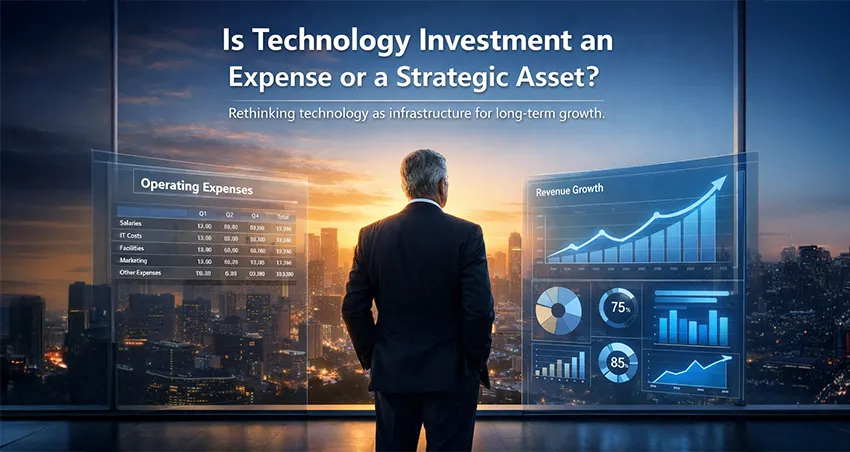
Is Technology Investment an Expense or a Strategic Asset?
In many organizations, technology investments are still evaluated primarily as operational expenses.
Budget discussions often focus on short-term costs rather than long-term value.
However, this perspective is increasingly outdated.
In today's competitive landscape, technology is no longer just a support function — it is a core driver of growth, efficiency, and strategic advantage.
Moving Beyond Cost-Centric Thinking
Treating technology purely as an expense limits its potential impact. When decisions are made based only on upfront costs, companies risk underinvesting in systems that could significantly improve performance. The real question is not 'How much does this cost?' but rather 'What value does this create over time?'
Modern businesses that shift their mindset begin to evaluate technology based on:
-
Operational efficiency gains
-
Time savings across teams
-
Reduction of manual errors
-
Data-driven decision-making capabilities
Technology as a Value Multiplier
Well-implemented technology does more than automate tasks — it restructures how a business operates. From finance to sales, integrated systems enable organizations to:
-
Track performance in real time
-
Identify inefficiencies early
-
Optimize resource allocation
-
Improve collaboration across departments
This creates a multiplier effect, where each improvement contributes to overall business performance.
The Strategic Advantage
Companies that view technology as a strategic asset position themselves differently in the market. Instead of reacting to problems, they build systems that prevent them. Instead of relying on fragmented tools, they operate within structured, connected environments.
This shift leads to:
-
Faster decision-making
-
Better scalability
-
Increased transparency
-
Stronger financial control
Long-Term ROI vs Short-Term Spend
The return on technology investment is rarely immediate — but it is cumulative and measurable over time. Organizations that invest strategically often see:
-
Lower operational costs in the long run
-
Higher employee productivity
-
Improved customer experience
-
Stronger competitive positioning
The key is to align technology investments with business goals rather than treating them as isolated expenditures.
Conclusion
Technology is no longer optional, and it is certainly not just a line item in the budget. It is a foundational element of modern business strategy.
Organizations that continue to treat technology as an expense will struggle to scale efficiently. Those that recognize it as a strategic asset will build stronger, more resilient operations — and gain a clear advantage in an increasingly data-driven world.